
Fulton Release: Parole or Probation
A person seen outside a jail or prison may still be serving a sentence. The key is the legal source of supervision. Fulton County probation is a function of the local court system. The Illinois Department of Corrections and the Illinois Prisoner Review Board handle state-prison release and mandatory supervised release. Illinois often uses the term mandatory supervised release, or MSR, for the supervised part of a sentence after prison.
The distinction matters because each office maintains its own record. A Fulton County court disposition can state probation, conditional discharge, or commitment to IDOC. An IDOC result may state PAROLE and show a parole district. Neither source should be stretched beyond its field labels.
| Point | Parole or MSR | Probation |
|---|---|---|
| What comes first | An IDOC prison term | A court sentence, sometimes with limited jail time |
| Main public proof | IDOC status, Parole Date, district, and PRB records | Fulton County court docket and sentencing order |
| Local contact | The assigned state parole district, if publicly identified | Fulton County Probation |
| End point | Discharge from the state sentence after supervision | Court-ordered completion or discharge |
- Parole
- Community supervision following release from prison under the applicable sentence rules.
- Probation
- Court-ordered supervision served in the community.
- MSR
- Mandatory supervised release, the supervised period that follows many Illinois prison terms.
- Discharge
- The formal end of the sentence or supervision, not merely departure from a facility.
Verify Fulton Post-Release Supervision
Start with the last known custodian and the sentence. A person released from Fulton County Jail may be on probation, may have no supervision, or may have been transferred. A person released from Illinois River Correctional Center may be on parole or MSR. Roster disappearance alone settles none of those questions.
- Search the Fulton County case through Judici. Match the case carefully and read the disposition, sentence, probation, revocation, and closure entries.
- For an IDOC sentence, use the IDOC offender search. Search by IDOC number when known, or use name and birth data with care.
- Read each IDOC label separately. PAROLE indicates release from prison to supervision. Parole Date is not the same field as Projected Discharge Date.
- Check the Illinois Prisoner Review Board when a parole hearing or board decision is relevant.
- Contact Fulton County Probation for procedure in a known local probation case. Confidential case details and reporting information may not be public.
If sources conflict, keep the agency name and access date with each result. A court sentence establishes legal authority, while the sheriff or IDOC custody record establishes the physical transition. The broader Fulton County released-inmate search path explains how to follow a transfer between custodians.
Fulton County Probation Contact
Fulton County Probation serves local court matters. It is the right procedural contact when a known case shows probation, but the office is not a general public locator for everyone released from the jail. Ask about the process for confirming a public court status or obtaining the relevant court record. Do not seek a private address, check-in schedule, treatment detail, or other protected supervision information.
Fulton County Probation
Fulton County Courthouse, Room 204
100 N. Main Street
Lewistown, IL 61542
309-547-3041, extension 220
Monday through Friday, 8 a.m. to 4 p.m.
The official Fulton County Probation contact page is the source to recheck before calling. A case number and the exact public docket entry make a question easier to route. Probation staff cannot convert a jail departure into proof of probation unless a court record supports that result.
Fulton Supervision Status Changes
Supervision conditions come from the sentence, release order, and supervising authority. Public material may show that supervision exists without disclosing each rule. A violation allegation can lead to a court filing, warrant, revocation process, or return to custody. It is not the same as a final finding. Likewise, the term absconder generally means the supervising agency believes a person stopped reporting or cannot be located. It should not be inferred from a stale online result.
For probation, examine the Fulton County docket for a petition to revoke, warrant entry, hearing, order, or later disposition. For parole or MSR, compare IDOC status with the relevant PRB material. Illinois VINE can send custody-event notices, but it is not a parole-condition database and cannot correct an IDOC, court, sheriff, or PRB record.
When a safety or legal issue depends on a current warrant, contact the court or responsible law-enforcement agency. Do not rely on a cached page. Note: A transfer, violation hold, and final revocation are separate events and should remain separate in any custody timeline.
Fulton Parole Hearing Records
PRB hearing pages are relevant to a narrower set of Illinois sentences. They should not be used to promise that every person in IDOC custody will receive a traditional discretionary parole hearing. Sentence law and offense date can place people under different regimes. First identify the sentence, then identify the proper board process.
The PRB publishes a yearly en banc schedule, current en banc results, and a past paroles registry. A scheduled date is not a grant. A result should be read with the IDOC identity and sentence because similar names can mislead.
The official yearly schedule shows how PRB organizes hearing dates for eligible cases.
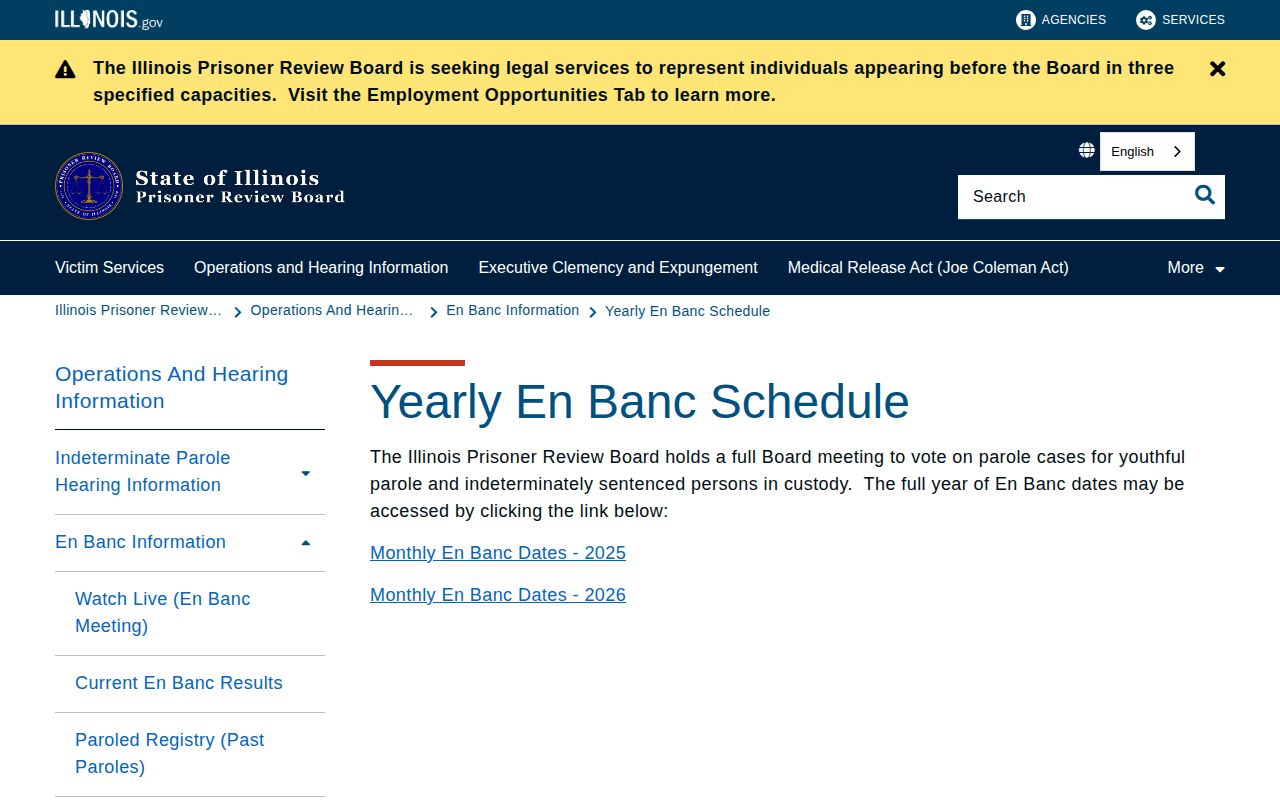
The image supports the calendar route, not a conclusion that a specific person was released or discharged. Current results and the person’s IDOC record must supply that answer.
Fulton Release Notification Layers
VINE and PRB notification serve related but distinct roles. Illinois VINE reports participating custody events such as release, transfer, and escape. PRB Victim and Witness Services offers a separate registration route for notice concerning release, escape, or death, with an option related to a current photograph upon release. Registration in one system should not be assumed to create registration in the other.
The PRB notification form is not a public search for Fulton County released people. Victim contact details must remain private. VINE support handles notification delivery, while the agency that created the underlying event handles corrections to that custody record.
Which Fulton Release Office Answers
This is the distinctive local supervision issue for Fulton County: several offices may hold one piece of the answer, but no single office owns the whole timeline. Fulton County Probation handles local probation procedure. The Circuit Clerk maintains court orders and docket material. IDOC holds prison status and parole fields. PRB maintains its hearing and decision materials.
A focused question gets a better result. Give the custodian its own field label, case or IDOC number, and the date that appears wrong. Fulton Probation cannot change an IDOC Parole Date. PRB cannot rewrite a Fulton court judgment. VINE relays supplied events and does not own the source entry.
Fulton Supervision and Final Discharge
Supervision ends through the controlling legal process. A probation case may show successful completion, discharge, revocation, or another court order. An IDOC record may carry a Projected Discharge Date while a person is on parole. That date is the anticipated end of supervision, not the date the person walked out of prison, and it may change.
Full discharge can also make an older IDOC record harder to locate. IDOC’s no-result explanation includes completion and discharge of the sentence or parole, but a no-result by itself is weak proof. Spelling, identity, search coverage, and data changes can produce the same screen. Preserve the sentencing disposition and seek an official record when exact historical proof is needed.
Illinois public-record law supports access to specific agency records, subject to exemptions and confidentiality. Ask for the named record rather than every file on a person. For Fulton probation, that may mean the public sentencing or discharge order from the clerk. For state supervision, it may mean an IDOC status record or PRB decision. Note: Always retain the words “projected,” “parole,” and “discharged” exactly as the source labels them.
Fulton Supervision Record Boundaries
Public confirmation should stay tied to the question the record can answer. A Fulton County docket may establish that the judge imposed probation, set a term, later filed a revocation matter, or entered a discharge order. It does not publish a probation officer’s full case file. The local office may confirm procedure in a known case while withholding details protected by court rules, privacy law, or supervision practice.
An IDOC result has similar limits. Status, Parole Date, parole district, Projected Discharge Date, photograph, and sentence blocks can help verify the correct person and stage of sentence. They do not reveal a private residence, reporting plan, treatment record, or every condition. PRB hearing results answer the board question shown in that record. They are not a substitute for the current IDOC status.
Use a narrow records request if a public source is incomplete. Name the agency, person, case or IDOC number, date range, and exact record. Ask the Circuit Clerk for a sentencing or discharge order, IDOC for its status record, or PRB for the identified decision. A precise request reduces mistaken identity and avoids collecting private material that does not help confirm Fulton County post-release supervision.